


How to Give Yoga Corrections (10 Tips for New Teachers)
June 7, 2026
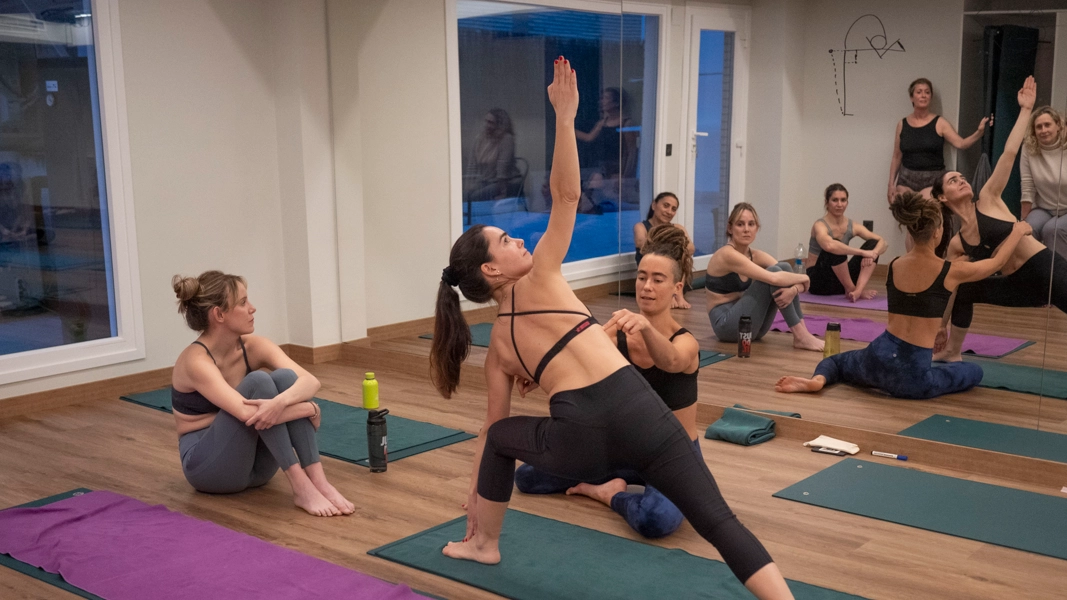
How to give yoga corrections in a Bikram Yoga class
Sometimes at teacher trainings we joke that “new teachers are blind and new students are deaf.” As new Bikram teachers, a great deal of concentration and attention goes into saying the right words and keeping the class going. It can be challenging to notice the details of what is happening around us. Another way to think of it would be that new teachers can see, but don’t have the mental space to process the information about what they are seeing before they need to move on to the next thing.
Giving clear verbal yoga corrections and alignment cues in a Bikram hot yoga class is a skill that develops with practice. With experience, we grow in our ability to see the hot room and respond to it in real time. After we start to be able to process what we see, we move on to being able to interact with individual students during class.
At the same time, don’t feel pressure to give yoga corrections. Sometimes newer teachers feel that they aren’t teaching a good class if they do not give corrections. It’s absolutely possible to teach a stellar class where students feel seen without giving a single correction or saying names. No corrections is better than saying something just because you feel like you should. Receiving a not-great correction can break or lessen trust between student and teacher. Learning how to give yoga corrections well takes time- like practicing the postures, don’t be in a rush to get somewhere.
When not to give yoga corrections
Not every moment is the right time to correct—here are key situations where it’s better to hold back.
- You tried to correct the student and they ignored you. Usually if someone wants to do the correction but genuinely cannot today, something in their body language or face will indicate that they tried to do it. If you sense a “wall” from the student, they either did not hear you or they are resistant to the correction. If you sense it is the latter, back off, and leave this student alone today.
- The student is struggling physically. Maybe they sat down or you can see that their breathing is not under their control. Today they need to prioritize self-management, and encouragement is more useful than a correction. Save the alignment fixes for another day. Correcting when someone is simply trying to stay on their feet says “I’m not able to see how hard you are trying,” which doesn’t make the student feel seen.
- The student is a beginner. It’s ok to give beginners a few simple corrections, but for the most part, allow them to work it out. Today they just need to have an “I’m new at this” experience. Overcorrecting a beginner can be overwhelming and potentially embarrassing for them if they are feeling self-conscious.
Why trust matters (and how to build it)
As teachers, our primary goal is to gain the trust of the room, and learning how to give yoga corrections well depends on that trust. When the students trust the teacher, they are much more able to have a “your mind, my body” experience. The more trust a student has in the teacher, the deeper they will be able to go in class on all levels. Distrust equals tension in the body.
Trust begins at the front desk from the first interaction. Even in the busiest sign in, a genuine smile and eye contact go a long way and say “I see you.” In the room, build basic trust through good cues, solid timing, and the feeling that the teacher wants to be there.
How to start giving yoga corrections
As a newer 26&2 teacher, learning how to give yoga corrections starts with confidently teaching a dialogue class. From there, one easy way to make simple corrections is to recycle the dialogue by simply repeating a line and adding a student’s name to it. You might find that you feel awkward or nervous at first- that’s ok! One of the best ways to learn how to correct is to notice what didn’t work. So, if it doesn’t go as well as you wish, file that information for next time! In time, you will develop your own best practices with corrections.
Be inclusive
Some bodies are easier to correct than others. You might notice that you can more easily “see” bodies that you yourself relate to. Be careful not to zone in too much on any one student, even if you are able to “see” more of them than others. A good rule of thumb is to avoid saying someone’s name twice in a row without other names in between. Spread your attention around.
Say it to everyone
The corrections you give are usually useful to more than one person. Avoid whispering a correction to a student unless there is a privacy issue. Say it loudly so that all may benefit from it.
Your job is to get them to hear you
Be clear on your priorities
Sometimes you see several things that you could comment on and you have to prioritize. Here is a formula for what to address first:
- There is a safety concern to handle (ex: going down unsafely in Toe Stand)
- They are doing something that takes away from the primary purpose of the posture (ex: straightening their elbows in Cobra and therefore removing the lower back muscle contraction)
- A miscellaneous detail is off that doesn’t hugely take away from the purpose, but is incorrect within the tradition (ex: their fingers are spread in Standing Bow)
Be genuine with compliments
If you give an affirmation after a correction, the student may assume they nailed it. Avoid telling a student that they adjusted correctly if they did not. Ex: you told Jane to bring her right hip up, but her hip did not move. Avoid saying “that’s it” “you got it” or something else that suggests the correction is complete. This can actually break trust, as the student knows that they didn’t do it. It’s ok to acknowledge that the correction didn’t happen today, but “keep focusing on right hip up.” Some corrections just take time, and now the student has something to focus on each time they do that posture, and another reason to come back.
How to see the hot room
If you are a teacher who is interested in developing their ability to see the room, keep this in mind: it is correct that you do want to constantly scan the room, especially in key moments (ex: Fixed Firm set-up.) But, if you scan too quickly, it is more difficult to notice details about any one person. Let your attention rest on a student for a few beats and see what you notice, then move on. You don’t need to say anything at first, just practice making observations and then move to the next person.
Be present
Most importantly, follow your intuition based on what is happening in front of you today, regardless of any rules or best practices.
Join the conversation (for teachers)
If you’re a teacher with thoughts, questions, or your own experiences around how to give yoga corrections, we’d love to hear from you. Our forum includes a dedicated space for teachers to discuss teaching, share what’s working (and what isn’t), and learn from each other. Join the conversation.